Google searches are a commodity. You have to win the click.
The game: know how much demand exists in your category, capture as much of it as you can afford to capture profitably, and stop trying every product Google is selling this quarter.
Book a strategy call

Google feels complicated.
You've been spending real money on Google for years, but the results are continually slumping in the wrong direction. Even when results look okay, the account is far from scalable as is.
- Your account structure is very complicated with 10+ campaigns, dozens of Ad Groups and 100+ keywords. But you aren't sure where the real value is coming from.
- You're paying premium CPCs on core keywords but you aren't sure if that's because they're truly expensive, or something is wrong with your bidding or Quality Score.
- The agency keeps recommending PMax, AI Max, YouTube, Display, Lead Forms. None of this is showing value, in fact, it seems to be the opposite.
- You never hear about ad copy optimization, and when you see your ads in the wild they are far from what you would consider "strong" ads.
- You intuitively feel there is a lot of leaking spend, but you don't have anyone on your team currently who has the expertise to find it and fix it.
What every strong Google Ads account is built on.
There's no clever tactic that fixes a broken foundation. These five things have to be true before campaign tuning, bidding strategies, or new Google products matter.
An offer people want.
Ads that work.
- i.Mirror search
- ii.Compete with value
- iii.Align search to LP
Ads shown to the right people.
A funnel that builds value beyond the price.
A smooth purchase process.
Beyond this, Google Ads accounts need an iterative ad copy and landing-page alignment process, management of Quality Score, and avoid shiny object syndrome chasing every new product Google recommends.
It's also important to know how to work with Google's algorithms (broad match plus strong conversion signal), without giving unquestioned control over to Google's automation.
How we run Google Ads.
Running strong Google Ads campaigns is not glamorous work, but rather very logical and formulaic.
Know your demand pool.
It's important to know three things. First, how much search volume exists for your category, broken out by keyword? Second, has that volume changed over the last 3 years? Third, what percentage of those searches are you currently showing up for?
Make the algorithm match the right intent.
Broad match is the default play for any serious advertiser, but only when paired with strong conversion signal and a watched search term report. Broad match alone is a recipe for wasted spend. Broad match + strong purchase tracking + a weekly search term audit is how the algorithm actually starts matching your keywords to the searches you want.
Ad copy that wins the auction, plus housekeeping.
Ad copy isn't just about presenting the brand well, it's also about psychologically confirming "what this is," and competing strongly against competitor ads with unique value. In addition, Quality Score actually does matter for your ad costs. Anything under a 7 increases your costs artificially.
Know your competitors' offers.
Most people open multiple tabs from Google, so it's important to know what your competitors are offering. This isn't about copying your competitors, but it is about making sure you have a unique position in the market that is clearly communicated in your ad copy and at first glance on your landing page.
Bid simply, expand intentionally.
We simplify and modernize the account structure, and we contract rather than expand on products and keywords to drive better returns. Unfortunately, Google has very large sales teams pushing to monetize their traffic, which is often not helpful for advertisers trying to monetize their ad spend. It's important to know when to follow Google's recommendations, and when to politely decline them.
Spend less on what doesn't work.
Concentrate on what does.
Most Google accounts leak budget across a long tail of campaigns that aren't really pulling their weight. The work is finding the winners, pulling spend off the rest, and letting the algorithm compound on what's already working.
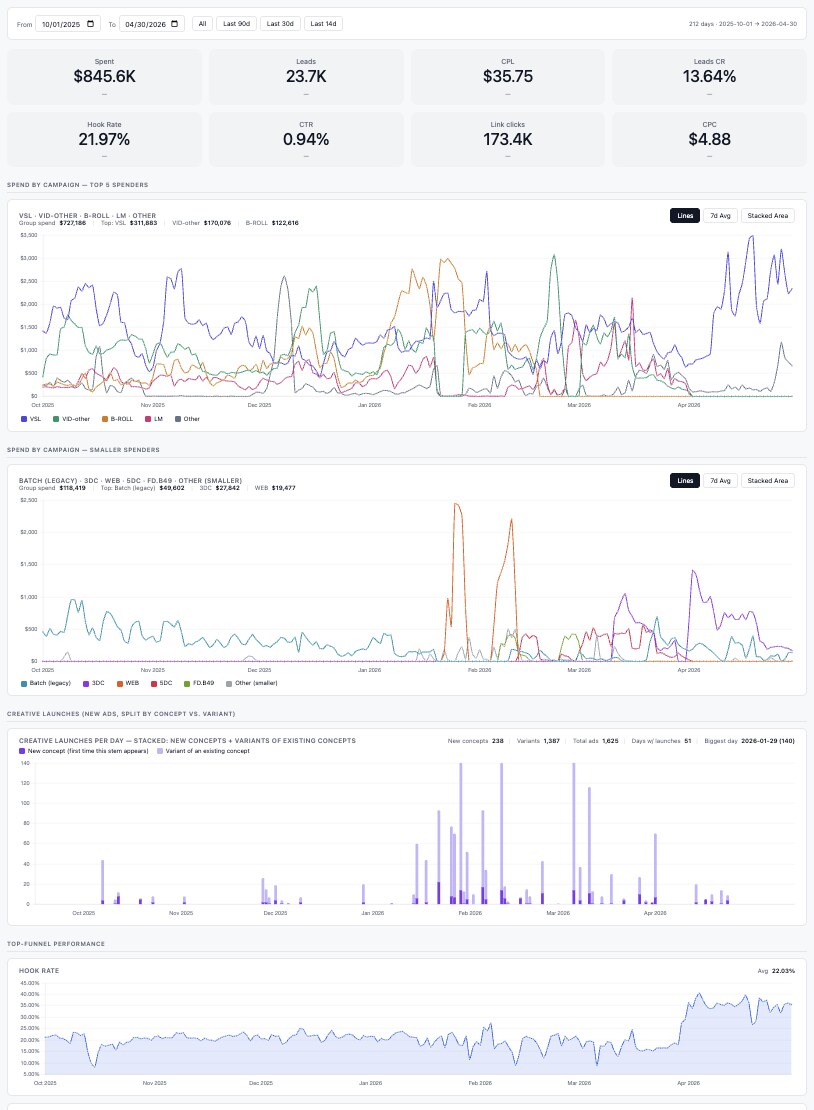
Spend concentration, before and after consolidation
Campaign-level spend distribution, illustrative of the shape we're trying to create. Before: dozens of campaigns competing for the same budget. After: spend concentrated on the campaigns that are actually working.
A real cadence, not a quarterly review.
Here's what each cadence actually looks like on a Google engagement.
Week 01
Audit + Restructure
- Full account audit
- Campaign consolidation plan
- Search volume available vs captured
- Conversion signal validated
- Success metric agreed upfront
Weekly
Trendline + tune
- QS trendline review
- Search-term audit
- Budget reallocation
- Negative keyword pruning
- Conversion signal QA
Bi-monthly
Ad copy refresh
- 50/50 framework retest
- Cut bottom 10% of headlines / descriptions and replace with tests
- Promote new winners
- Landing page alignment check
Day 90
Decision point
- Goal review against agreed metric
- Honest fit assessment
- Continue, scale, or part ways
- No auto-renew pressure
A dashboard built around conversion signal.
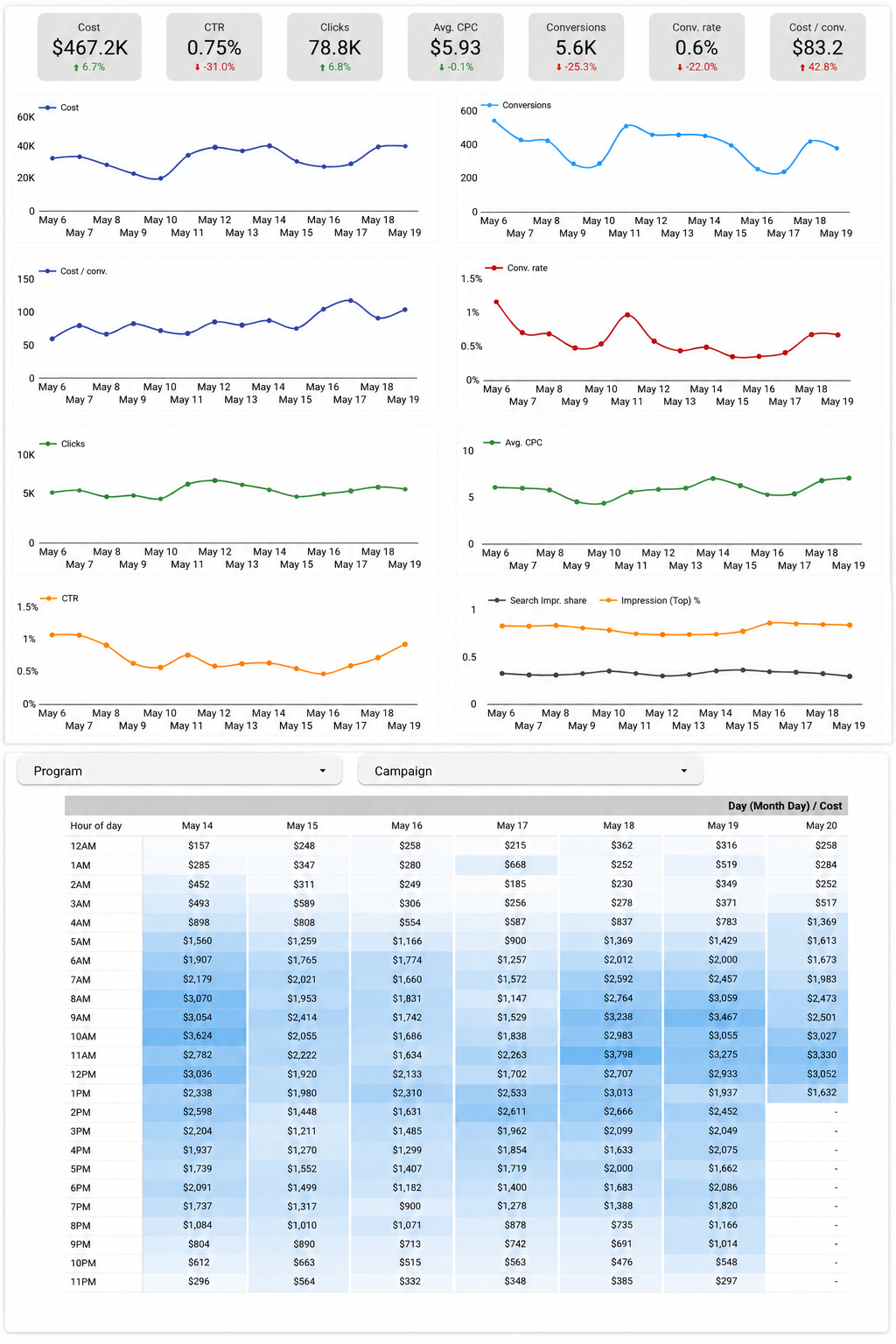
Every Google engagement gets a custom dashboard that surfaces what most Google reporting buries: Customer Journey trendlines, Quality Score trendline, search-term-to-keyword alignment, and backend ROAS by campaign.
Google Performance Dashboard
Customer Journey trendlines, Quality Score trends, campaign-level concentration, ad copy refresh cadence, and backend ROAS overlay. Built fresh for your account in week one.
- Customer Journey trendlines
- Account-wide Quality Score trendline
- Top 15-20 keyword spend concentration
- Search-term-to-keyword alignment audit
- Backend ROAS overlay vs Google-reported ROAS
Real account. Real numbers.
Lifted Google ROAS 61% across an 8-month scaling push, by rebuilding the account around Quality Score.
Inherited an over-built Google account: SKAGs on exact match across 16+ competing campaigns, manual CPC bidding, keywords sitting at Quality Score 2 quietly burning budget. Account-wide Average Quality Score was 4.5, below average. Every click was costing more than it should.
I consolidated 16+ campaigns into 3, dismantled the SKAGs, shifted to broad match with Maximize Conversions bidding, and Paused every Quality Score under 2. Ad copy moved onto a monthly refresh cadence with the 50/50 rule. Quality Score climbed from 4.5 to 7.55, crossing into above-average territory by month four. ROAS followed: 1.77 trough to 2.86 exit, a 61% lift, even as monthly spend ran 29% higher than the pre-engagement baseline.
Read the full case study →Two ways to work together.
The 90-Day
Google Sprint
- Defined success metric agreed upfront
- Full account audit + restructure plan
- Custom dashboard built in week one
- Weekly trendline + tune cycles
- Bi-monthly ad copy refresh
- Direct access to senior strategy, no junior handoff
The 12-Month
Partnership
- Everything in the 90-Day Sprint, sustained
- Senior strategy inputs + AI-scaled outputs
- Ad copy production at agency volume
- Ongoing dashboard evolution
- Quarterly business reviews
Best fit: brands spending $30K/mo+ on Google with active search demand in their category.

Want Google Ads back on track and scaled with ROI?
One 30-minute call. Honest read on what's broken in your Google account, what's salvageable, and whether we're a fit. No pitch deck.
Book a strategy call